What we can learn from Audra Winter

A cautionary tale to writers about getting lost in the sauce, girlbossing too close to the sun, and what really matters to your readers.

TLDR: it’s the writing.

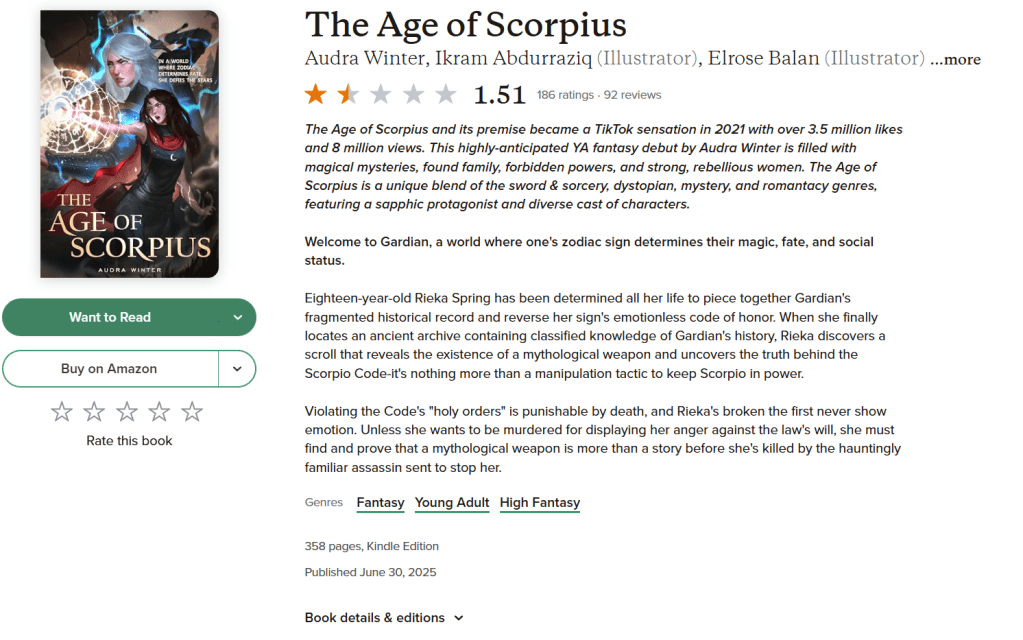
Earlier this year, new author Audra Winter made waves in the Booktok community with the release of her much anticipated debut YA novel, Age of Scorpius. But all that glitters is not gold, and the 22 year old author found herself facing backlash after the book reached readers’ hands, and reviews started coming in.

This is all everyone seems to be talking about right now – or maybe I just need to hard refresh my Tiktok and YouTube for you pages. Anyway. It’s all I’ve been seeing for the past month or so, and everyone seems to have thoughts about it. So I decided to add absolutely nothing of value to it by throwing my opinion in as well.
Let me be clear: I am not here to rag on this woman, nor accuse her of scamming, or call into question her past behaviours, or her neurodiversity. I am going to talk simply about the situation at hand, the cost of girlbossing too close to the sun, and why all the art in the world won’t compensate for poor writing. Also, this is all my opinion, this is all allegedly, please don’t sue me. Thank you.

Let’s dip our toes in then, shall we?

At first glance this idea looks pretty freaking amazing. Zodiac magic, a fantasy dystopian post-apocalyptic world? Beautiful artwork with a strong anti Ai stance? Lesbians???

Why, an idea this good could never fail!
Aw, fudge.

So, what happened?

So how does an idea this incredible, at a time when the market is primed and ready for it, miss the mark? (let me tell you: it’s the writing – there, now you don’t have to read the part where I ramble, unless you want to of course).

A very, very brief timeline from what I can piece together: In 2021, Audra was posting to Tiktok and introducing the world of Gardian (yes it’s spelled Gardian in the book, not guardian). This continued until around 2022, where things went quiet for a while after she signed with a literary agent and was preparing the book for sale to potential publishers. Audra re-emerged on Tiktok around 2024, re-introducing her book with a Kickstarter campaign.

Some time later Audra abandons the Kickstarter to focus on presales of the book via Tiktok shop, and it all takes off from there. Pre-orders flood in, and suddenly she’s sold around 6000 copies – unprecedented for an indie author. Audra flips the script here, pivoting from her previous pity marketing tactics to “I’m Audra Winter and overnight I became the owner of a 6 figure multimedia business”, with claims she has hired a team of 15 artists to further develop the world of Gardian, and that she had hired the editor of the Hunger Games to work on her book (allegedly, please don’t sue me).

People were very excited for this.
The problem

The book was not well received.

Reviews and reactions came flooding in, and soon the Goodreads page for The Age of Scorpius was swept up in a tide of 1 stars (as of checking yesterday, the rating is currently at 1.51). Readers began demanding refunds. Nightmare fuel for every author. I wouldn’t wish it on my worst enemy… Actually, I might. I’m a little petty. Is it petty to have a collage of 1 star reviews of your enemies books as your desktop wallpaper? You decide!
I had a look at the writing myself, and (in my opinion, don’t sue me), it does very much feel like it was written by a 12 year old (her age when she claims she started this world), and I can confirm that when I was 12 years old, I was writing fanfiction at a similar level to this. If you want to see it for yourself (the book, not my fanfiction), a sample can be found here.

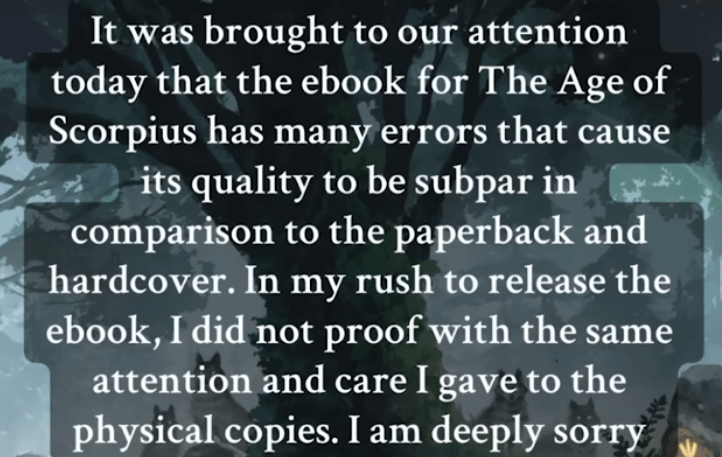
Audra responds (with what I can only imagine is the royal ‘we’, because as the author, surely it’s only her that is responsible for the book, and not the artists or editors she hired), saying that the e-book version had missed a proofread and would be fixed. Fair enough.
But, it doesn’t end there. There’s issues with the paperback too – grammatical flaws, confusing descriptions and a fair few plot holes. Audra steers the conversation away from quality issues to the impact on her mental health, and says she will be taking a break from social media. I’m not here to comment on this side of things, I want to stay with the writing – I’m adding this for context as to why people became so frustrated.

Now, forgive me here because the timeline gets a little skewed as I try to get my head around it all.

After all the feedback, critiques, and varying levels of criticism, Audra released videos saying that the book will be re-released with a new editor and new artwork from her team of 15+ artists. This has not been well received, with many stating that the artwork isn’t the problem, that it was never the artwork, and the writing needs to be significantly improved before anything else is even considered.

Throughout this, Audra does not seem to apologise or take criticism well, at times claiming that her main character is neurodivergent, therefore the prose and dialogue would be different to regular writing, or blaming the poor prose on previous editors (allegedly, don’t sue me). Many, including other neurodivergent writers, took this as a poor excuse for the subpar writing. People became increasingly frustrated with Audra’s responses, and criticisms quickly steered from the writing quality towards Audra’s character (which I am not here to dunk on. I don’t think anyone should be doing any dunking unless it’s biscuits in tea), and accused Audra of weaponizing her neurodiversity in the face of genuine critique.

Side note: I’m going on a slight tangent here, as a fellow autistic individual: It irks me whenever people accuse an autistic person of weaponizing their disability. It is a disability. Joely Black does a great job of breaking this aspect of the situation down, so here’s the link to her video.

Still, Audra does not help herself (in my opinion, please don’t sue), often appearing arrogant and self-assured. She’s made claims of having 10 years of experience in the publishing industry , writing 10 books (despite Age of Scorpius being her self-proclaimed debut novel), and of having her 10,000 hours of practice in the bag, making her a master in writing. By that logic, I should be the next Shakespeare. Trust, I’m not.
Unfortunately, just because you’ve been working on your world for 10 years, doesn’t mean you’ve been working in the publishing industry for 10 years (in my opinion, don’t sue me). The self published novel you put out at 14 doesn’t really count either (in my opinion, don’t sue me). I put out a comic series at age 14, and it was not good. No, I’m not going to be sharing it.
Audra also seems to struggle a little bit with truth telling (allegedly, don’t sue me). A bunch of people who are much better at researching than I, have found several inconsistencies with her story. One of these being why things ended with her agent. In one video, she tearfully claims to have been let go by the agent, in another she says she actually left them and decided to self publish (I’m not putting allegedly here, it’s in her own videos). And it doesn’t end there. This has caused people to question many things Audra has said, leading to accusations of her being a scammer (I personally don’t think she is, but who’s to say).

Get to the point!

Pride cometh before the fall.

Unfortunately for Audra, this is the internet. Much like elephants, the internet never forgets. And it never forgives. Jk, people do worse shit than this all the time and their careers remain completely unaffected. In two years, there’ll be another drama worse than this one, and Audra will be free.

What can we learn from this?

It’s all about the craft, maaan.

If Audra had been going to writing classes, seeking out workshops, practicing prose and fine-tuning her craft, then yes, the 10,000 hours in question would certainly help her on the way to becoming a master. BUT – with any craft, you never stop learning, and the second you declare yourself a master of something, someone is going to come along and humble you. A 12 year old is certainly not the master of much (not including Shaolin monk kids in this statement, because damn), and it doesn’t matter that she worked on her world for a decade if the world still doesn’t come across as well developed and well written.

Here’s what I, in my ‘unc’ status, advise to writers and soon-to-be authors who are worried about being in this situation: before you publish, git gud, scrub. It all comes back to: just write.

I mean it. Work on your craft. It’s not super fun or sexy, or gets you going viral on social media, it’s just good ol’ fashioned grinding (which actually can be quite fun if you’re into that sort of thing).

Anyone who’s played Hollow knight will know how important it is to git gud.
Screaming, crying, throwing up

If you truly want to be a writer, don’t get distracted by the shininess of being tiktok famous or being the next whatever – just write. Work on your craft. If you want to be tiktok famous, then by all means study the methods of Audra for self promotion. Go off, majesties.

All the other stuff aside, I do feel for Audra. She is obviously passionate about the world she’s created, and I think with some work and time, it could be something really cool. I can see why she had so many pre-orders. In a sense, she did everything right to promote Age of Scorpius. BUT – it just wasn’t ready, and the pride that inspired people to pre-order was the same pride that sent her flying too close to the sun. You can polish a turd all you want; no amount of pretty artwork, gilded pages, or girlbossing can compensate for immature writing. If anything, all the glamour set people’s expectations higher, which worsened everyone’s collective disappointment when reality hit.

I can’t even say this as a master, btw, because I am not a master at anything yet (unless its procrastination). I just have eyes and more than 1 functioning braincell.

Audra is living every one of our worst indie author nightmares. She’s at risk of becoming internet lore for all the wrong reasons, and we’ve all seen what that does to people. I genuinely hope it doesn’t happen to her. I know by writing about it, I’m contributing to the dialogue. Hopefully, it’s a contribution that doesn’t lead to negativity. This is a lesson for all of us about working on your craft and being willing to take criticism. By all means, share what you’re passionate about, share your joy of writing, share the joy of that world, but don’t lose yourself in the sauce, and don’t put the cart before the horse. Hey look, that rhymed. Maybe I am Shakespeare.
Sources

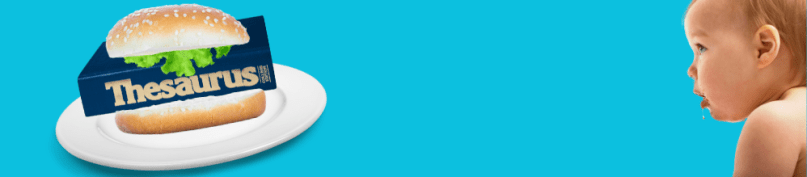
Image shows baby drooling at a burger, but the burger is a thesaurus in a bun

Opinion: Ima need you to stop eating thesauruses

One of the biggest mistakes new writers make, and how to avoid it.

I’m going to hold your hand when I say this (so you know I’m saying it with love) but STAAAHP eating thesauruses and puking them out onto paper. Stop it.


And before you get mad and start typing up those incredibly eloquent responses… calm down. This is to help you. And if you don’t want it, you don’t have to take it. We respect everyone’s boundaries here.

As a beta and arc reader I am sent books from authors wanting my opinion (some just want praise, but TOO BAD, I’m a prick), and over the last couple of years or so, I’m starting to see a pattern. Not a good one. With the recent rise and success of self-publishing (the success part mostly being uncle Jeff’s profit margins), anyone and their mums can write and publish a book with not too much effort (and with gen ai, you don’t even need to type. What a world we live in). This, in my opinion, is a good thing. Not the ai part. The freedom to self-publish part. Creativity should not be gate-kept, and I’ll stand by that statement, even if I also believe that some things should remain as inside thoughts or kept on AO3.


We don’t tell artists that they’re not artists just because their work isn’t in a physical gallery, so why do we keep shoving the mentality down everyone’s throats that you’re only an author if a traditional publishing house bought the rights to your book? Just look at furry smut artists. I know those guys are making bank. They’re still artists. Even if you don’t like it.

The downside, is that with the lowering of the gates comes a tide. Just as furry smut artists are still artists, any mediocre white dude who wants to jizz up a wall can call it art if he’s bold enough, and unfortunately I know a few circles who would eat that shit up. Not literally. Actually… Let’s not think about that.

Anyone can publish whatever they spew onto a page and call it a book. This is the cost of freedom, people. It’s a wild west out there. I’m not going discuss the quality of trad publishing taking a dive because yay capitalism, yay gen ai stealing our editing jobs, or say without a doubt that all self published books are terrible.

They’re not. Mine exists.

Let’s get back to the problem. Much like a weary teacher of gen alpha students, my advice to authors seems to be increasingly falling on deaf ears (if I don’t get messages hurling abuse at me). How dare I question their genius. They’ve done their ten thousand hours, damnit, so what do I know – I’m just a filthy, lowly reader. All that time I spent studying English Language & Literature at college means NOTHING.

The Problem

Short story for context: I recently received an arc of a book from an American writer who’d based their story in 20th century England. Admittedly I am a little more lenient with people who don’t live here, as they might have an idea of the UK that’s purely media informed, and therefore not accurate. It’s not actually Bridgerton over here, chaps. Even with that in mind, from the first page I was horrified. The main character spoke in such a strange, formal manner that I was immediately pulled out of the story. Side characters were also just as formal, using words that no one in their right mind would use unless they were giving an academic talk on the creation and development of the thesaurus.

“But I’m writing from another time!” – Sir, you are writing from the 90s.

We don’t talk like that. Nobody talks like that. We haven’t spoken like that since the Victorian era (arguably we didn’t speak like that in the Victorian era either), and unless your book is a historical drama akin to Jane Eyre, I do not want to see the Queen’s English appear on the page (Yes I know we have a King now, I don’t care).

You know why Colleen Hoover books sell so well? Because they use informal, every day language, and the masses relate to them. I’m not sure what that says about the masses, but there we go. And you know what? I enjoyed Verity, actually. There. I said it. I’m only using Hoover as a mainstream example here because A) her name is instantly recognisable and B) her writing style is very easy on the ol’ eyes. Of course, there are many authors who use poetic, achingly beautiful prose who are masters of their craft and bestselling authors. Brandon Sanderson is now a household name for fantasy writing, and I don’t have to pause every 30 minutes to look up a word that I’ve never seen before.

The point is that most of us plebs who read for entertainment don’t want to feel like we’re being beaten around the head by a thesaurus, and your job as a writer is to communicate clearly and effectively.

Anyway.

One of the biggest, hugest mistakes I see made by newer writers (I’ve also been guilty of it in my youth) is the use of overly formal language, with as many big words thrown in as humanly possible. Quite often it’s done to make the author appear more intelligent. I’m not sure where this behaviour stems from, perhaps from a fear of the writing coming across as YA (the horror), or maybe it’s to appease pseudo-intellectualist elitists who like to shit on any genre that isn’t the ‘modern classics’. Yes, yes, we’ve all read Animal Farm.

You don’t get brownie points for suffering, and you don’t get brownie points for weaponizing language. Not to sound like a very uncool school teacher, but it’s not big or clever. It just makes you look like this dude.


It’s like that one guy who works in a vinyl music shop, who hates anything popular regardless of whether or not it’s actually good. He’s the kind of guy who hates on K-pop Demon Hunters just because everyone else loves it. Or the “I’m not like other girls” girl who pretends to enjoy what she thinks is ‘high intellect hobbies’ for male validation because she has no sense of self, and would absolutely steal your man if she could. There is no greater anime villain. Besides Griffith, maybe.

So how do I avoid it?

Step 1: as with many things in life, the first step is to admit there’s a problem. Most newer writers who are very excited about their precious baby, do not want to hear bad things about it. Any form of criticism can feel like a personal attack, often because a certain amount of vulnerability comes with any creative output. I get it. I’m very sensitive about sharing my drawings, or my poetry in fear that someone will call it shit. But that’s the thing. I’m not trying to sell my poems or drawings to an audience. Those are mine. They are art, and can’t be judged unless I make them a product or offer them to the world.

Your novel that you want to sell to people, is a product. Like it or not. And you can absolutely say “well if they don’t like it they don’t have to buy it” and that’s fine… but you need to also be prepared emotionally when people don’t recognise you as the next Shakespeare and write reviews that reflect their customer experience.

Step 2: touch grass. I mean it. Go outside, sit in a park somewhere, or a bus, or a café, and just listen to people talking. Actually listen to how they talk. How people use slang depending where they are. How people out in the wild don’t adhere to hierarchy in the same way they would in a commercial or professional setting. How they talk to their children versus another adult. Does the server use a customer service voice then switch it up when talking to their co-worker? How do lovers talk to each other?

Most people have a limited vocabulary, especially in every day settings. I’m not going to say mastication when I mean eating. Think about how you talk to people on a daily basis. You need to converse. Or at least, consume enough examples of conversation to understand how it works. Most people can do this naturally (I say most – neurodivergent people may need to practice more than someone who is neurotypical).

Just as you wouldn’t want to be using gen Z slang in a historical drama (unless you’re deliberately subverting the genre, then by all means, go off, queen), you don’t want the Queen’s English featuring heavily in a modern, ordinary people setting.

While I’m at it – generations also speak differently and I see this happening with a lot of Gen X or Boomer writers who keep using their slang/speech for characters much younger than them. Heck, I even see it with Millennial writers.

Step 3: Really consider the type of media you are ingesting on a regular basis and understand the tropes/beats/prose that comes with it. If you want to write a gothic thriller, but you only read cosy romance, you’re going to have to consider what tropes are expected and acceptable in each genre, especially when it comes to prose. That’s not to say you can’t mix it up, but you have to understand the rules first in order to break them effectively.

What makes the Godfather so beloved? Why is Heat such a great freaking movie? Why is Bridesmaids so funny that one might pee a little every time they watch it? Why do we all love Chit??? Because of the way language is used to convey character and tone. If you want to write realistic, nuanced human beings who think and feel and get into hilarious shenanigans, you need it to reflect in the character’s voice and in the language you use.

A main character who speaks in nothing but riddles isn’t (typically) going to hook your readers.

Obviously I sent my feedback to the author and in the politest way I could suggested they consider a little more re-writing and editing before publishing, but I doubt they will. I always want to say to these authors to work on their craft first, then start looking at book publishing, but I can’t tell people how to live their lives. I can’t police someone’s creative journey (and rightfully so). I can only give my humble opinion on what I think is ‘good’ and even that’s going to look different to someone else. Who do I think I am, a literary agent???

Hopefully one day this author will naturally learn to move away from the stiff, overly formal writing that screams of a thesaurus being tortured for state secrets. Maybe one day I’ll stop being so judgy. One day.

TLDR: if you’re a new writer, try not to get bogged down in using big, fancy words and steer more towards natural dialogue. Study people in their natural settings and try using this as a reference for natural conversation and use of language. Consider what genres of media you consume and try to apply it to what you write.

What are your thoughts on this? Is it a worsening problem or am I just in a bubble? Am I the boomer in this situation, shaking my stick at the kids like an old man, accusing them of ruining writing with their tiktoks and their dark romance? Or is this just another rite of passage for new writers, that we all have to get through this phase before we learn better? Let me know!

Writing 101: Sweet Revenge

There’s just something so satisfying about a good revenge story…

We’ve all been there. Someone wronged you, and all you’re left with is the empty, soul sucking feeling of injustice, and a pain somewhere deep inside your epigastrium that just doesn’t seem to go away no matter how much whiskey you consume. It’s a feeling many of us are familiar with. Heck, I’ve seen my fair share of betrayal over my short time on this planet. I’ve gained enemies in the spaces left by people I thought were friends. Some asshole even stole my writing once. I know, right? The gallows aren’t good enough for them.
Anyway.

Somewhere in the pain, somewhere deep in the shadows of our psyche, is a burning desire for revenge. The fantasy plays itself out in our darkest moments. Maybe you get to give them a right telling off in front of everyone you know, or openly shame them on social media with tons of evidence backing up your claim, and they can’t argue with any of it so they delete their profiles, and literally run away from you at a convention when you confront them in person about it. Maybe they even lose their publishing deal over it… One can dream.

Maybe the crime is something more heinous than art thievery. Maybe they did something much worse. Maybe they really, actually hurt you, physically and mentally. Maybe they hurt someone you care about. And despite what my therapist tells me about it “saying more about them than it does about me”, and that sometimes people are assholes, and we need to let it go and not let the fact that they stole our writing then posted it back into the writers group as their own, poison us, hatred is like holding a hot coal, etc etc etc… frankly my dear, I don’t give a damn. This hot coal is one that was forced onto me, and I won’t feel satisfaction until I crush it.

And yes, getting justice can be great n’ all, but sometimes, justice just isn’t enough. It’s not enough to mourn your dead dog and move on. It’s not enough to see your wife’s murderer go to prison. It’s not enough to avenge your ruined wedding day and the taking of your unborn child. It’s not enough to tell your close circle of friends about the art thief and have them console you. No. Sometimes, you need to see the asshole who wronged you get exactly what they deserve.

What’s that? We should forgive them?

Bah. Forgiveness? Forgiveness is for God, and we’re not him.

What is best in life?

Simply forgiving and moving on doesn’t exactly make for an exciting story.

We love revenge stories (well, I do. I don’t know about you, personally). Just check out this top 10 list of revenge novels from the Guardian. And movies (arguably my favourite form of media) about revenge give us all a taste of that sweet, sweet catharsis we desperately need, without actually resorting to violence. An eye for an eye leaves the world blind, and all that. Revenge fantasies help us cope with the wrongdoing, especially when for many of us, there is no satisfying outcome, no justice.

Just ask anyone who’s suffered at the hands of a violent partner, or is the victim of sexual assault. Too often the authorities are either indifferent, incompetent, or powerless to help due to lack of evidence. What then? In the real world, we have to learn to live with it. Some of us go to therapy. Some of us meditate, or practice radical forgiveness. Some of us drink or take recreational drugs, or descend into the depths of depression. For some, revenge is living well and overcoming their encounter (arguably healthier than some of the other options).

But, when we get to see a protagonist take vengeance in media, there is something deeply satisfying about it. Like I said earlier, there is a side of us that yearns for retribution.

What makes a sweet revenge plot?

So what makes a revenge plot so satisfying? There’s some common elements that, in my humble opinion, work very well. And I’m not talking about poignant, bitter-sweet revenge stories, where ‘an eye for an eye’ is the outcome. This is catharsis, not critical thinking damnit. I’m not saying poignant, thoughtful revenge stories aren’t good by the way; they are. But, sweet-sweet revenge isn’t a gourmet meal from a Michelin star restaurant. It’s twice-fried chicken from your nan’s house after eating nothing but salad for 2 weeks.

1) The protagonist suffers enough that their revenge, in whatever measure, can be fully supported by the audience.
2) The protagonist has been clearly wronged – the victim of infidelity, robbery or worse, someone kicked their cat etc etc… And, if the protagonist is avenging someone, the victim in this scenario is an innocent (such as a child, puppy etc).
3) There’s a moment where the audience thinks the protagonist might not succeed – tension adds drama and invokes powerful emotions.
4) There’s a ‘gotcha’ moment – gotcha moments could be as simple as the nerdy girl having a full ‘glow up’ and really sticking it to her high school bullies. Or, it could be the moment the villain whips off their mask and boasts about kicking the protagonists cat/puppy/baby.
5) The villain is a shit-eating douche. Like, we HATE what they did to the protagonist (and/or their loved ones), and we can’t wait to see them get exactly what’s coming to them.
6) The protagonist goes through hell to reach their destination/goal.
7) The ending is satisfying and the justice poetic. Like, jump out of my seat and fist-bump the air level of satisfying.

Let’s have a look at some sweet, sweet revenge moments, shall we?

Disclaimer: I’m not saying these are the best moments of revenge of all time, they’re some that I particularly enjoy. Also, if it wasn’t obvious already: spoiler alert.

1) The Princess Bride: “Hi! My name is…”

The moment Inigo Montoya finally gets to slay the man who murdered his father, thus avenging him. The battle is tense, with Inigo repeating the phrase “My name is Inigo Montoya. You killed my father. Prepare to die.” Just before striking the killing blow, he utters “I want my father back you son of a bitch.” It is iconic, and every bit as satisfying as finding a £20 note in your coat pocket. But, with his revenge also comes freedom. He’s dedicated his life to avenging his father, and now he is finally free to be his own man, to pursue his own interests.

2) Kill Bill 1: Silly rabbit, tricks are for kids

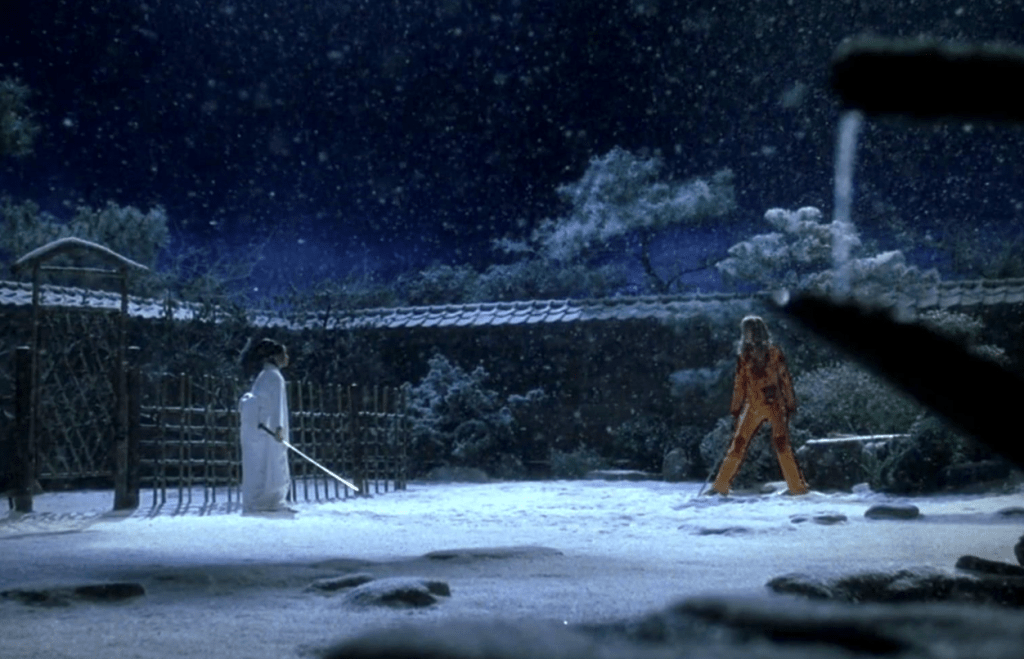
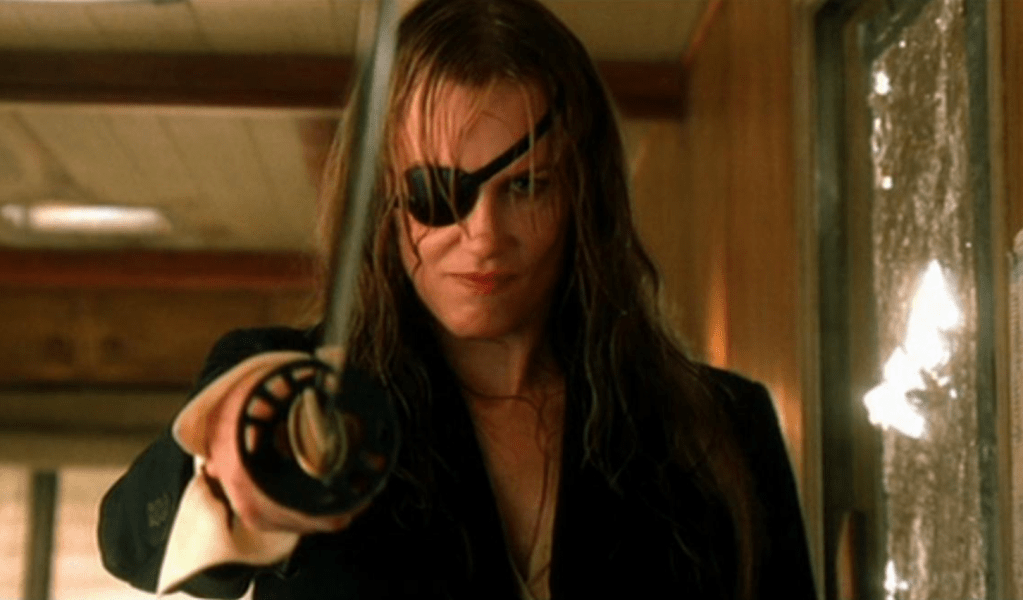
There are many satisfying moments in the Kill Bill movies, with the first films entire run through dedicated to Kiddo’s intense fight with Yakuza boss O’ren Ishii’s army, the ‘Crazy 88s’ in what I can only describe as a fierce love letter to old school Japanese martial arts movies. The film ends in a visually stunning fight scene, with protagonist Beatrix Kiddo finally taking down Ishii. The scene is so tense that even though Kiddo’s the main character, there’s a part of you that thinks “hang on, she might not make it!”

3) Kill Bill Volume 2: “Bitch, you don’t have a future.”

Since it’s one of my favourite movies of all time and the entire story is literally about a woman’s revenge, there are obviously many great moments in the plot. The most satisfying for me isn’t the moment Kiddo finally kills Bill. It’s when Kiddo utters the iconic line “bitch, you don’t have a future”, before plucking out the eyeball of rival assassin, and killer of her mentor Pai Mai, Elle Driver.

4) “That f*cking nobody is John Wick.”

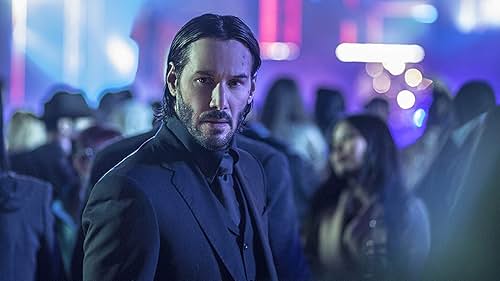
There’s just something so righteous about taking down the scumbag who stole your car and killed your dog, especially when said scumbag is a feckless, spoiled man-child who thinks daddy will protect him from everything. The entire nightclub scene is extremely good watching for any action movie aficionado, but there’s something so unsettling and satisfying about seeing a man gut punch his own son and tell him that the boogey-man is real, and “you will do nothing, because you can do nothing.” John Wick hasn’t even begun his revenge yet, and they’re already terrified.

5) Jackie Brown: The ol’ switcheroo

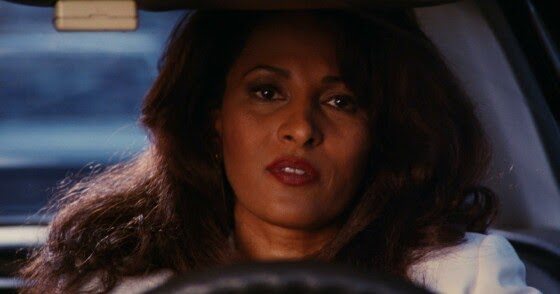
Another one of my all time favourite movies, with another case of getting sweet, sweet revenge. Jackie (portrayed by the incredible Pam Grier) is disrespected, sexualised, and mistreated by almost every man she encounters in this film. And even in the direction, she isn’t portrayed as a badass. She’s just an ordinary flight attendant who smuggles drug money. And she’s scared. She’s scared of getting older, of having nothing to show for her years of hard work. She’s tearful, hesitant, and she’s made mistakes. She’s utterly human in every scene. And she outsmarts everyone. With a slick music score and a masterclass in dramatic irony with multiple POVs showing the bag switch, the audience knows exactly what’s going on, and you’re cheering for her as she drives away, free as a bird.

6) Logan: little nightmares

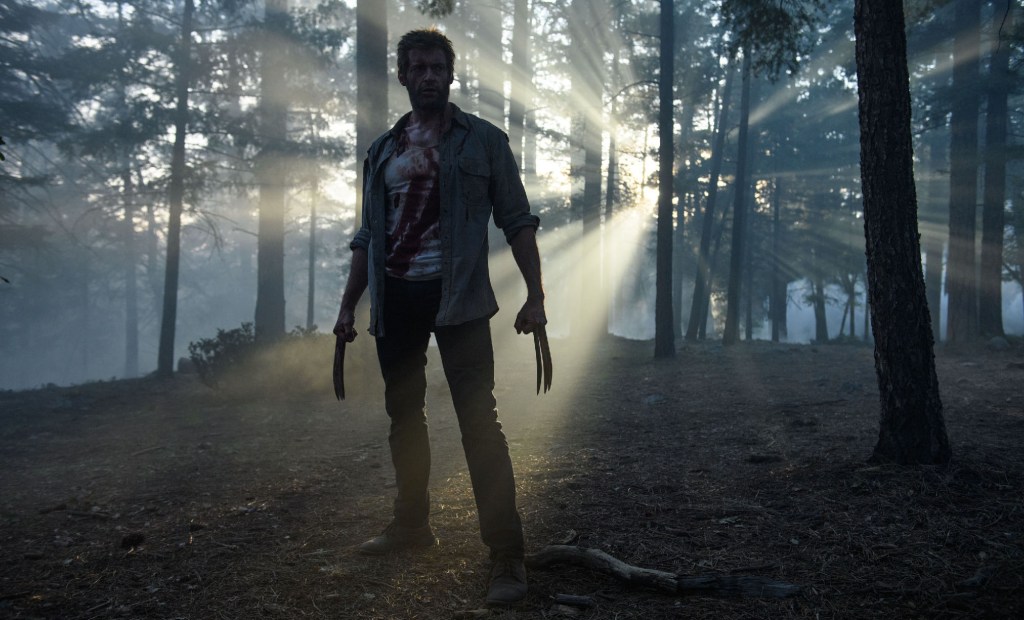
Raising kids can be a nightmare, especially when they’re kids with mutant superpowers… and they’re hellbent on escaping your secret government lab. The most satisfying moment in Logan is watching the children fight back against their captors in glorious, visceral detail.

7) Leon the professional: A gift from Matilda

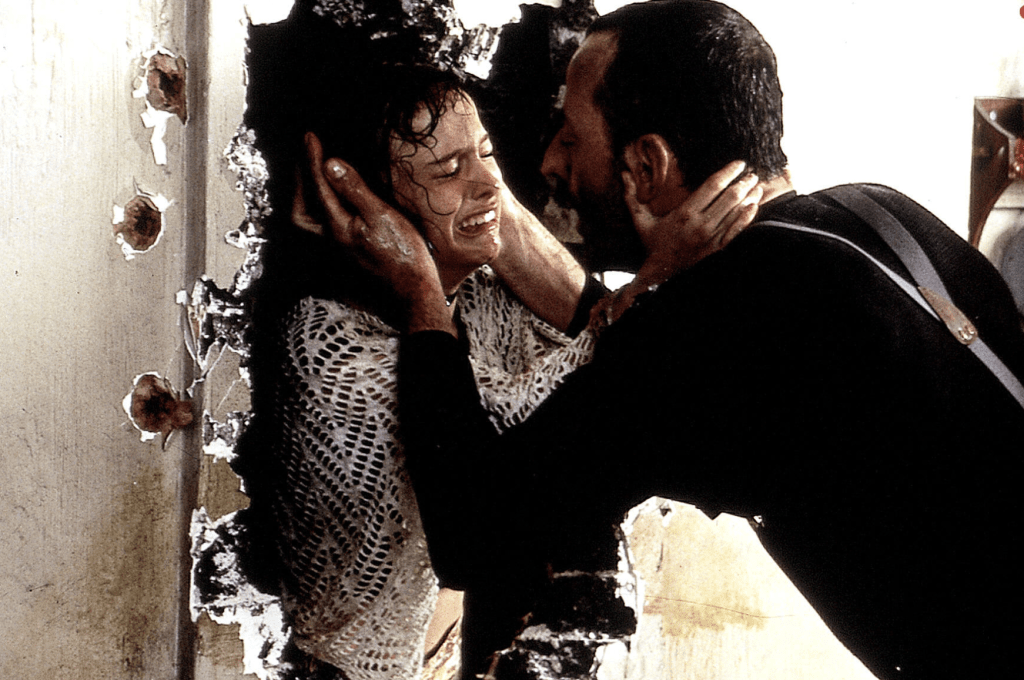
Another one of my all time favourites. As Leon (played by Jean Reno) lays dying after a gruelling battle to save 12 year old orphan Matilda from a full on assault from corrupt cops, he hands villainous detective Stansfield (played by Gary Oldman) something, whispering, “this is from Matilda”. By the time Stansfield has figured out that it’s a grenade pin, he’s blown to smithereens, and the audience knows that Matilda is finally safe.

8) Full Metal Alchemist: A roast to Envy

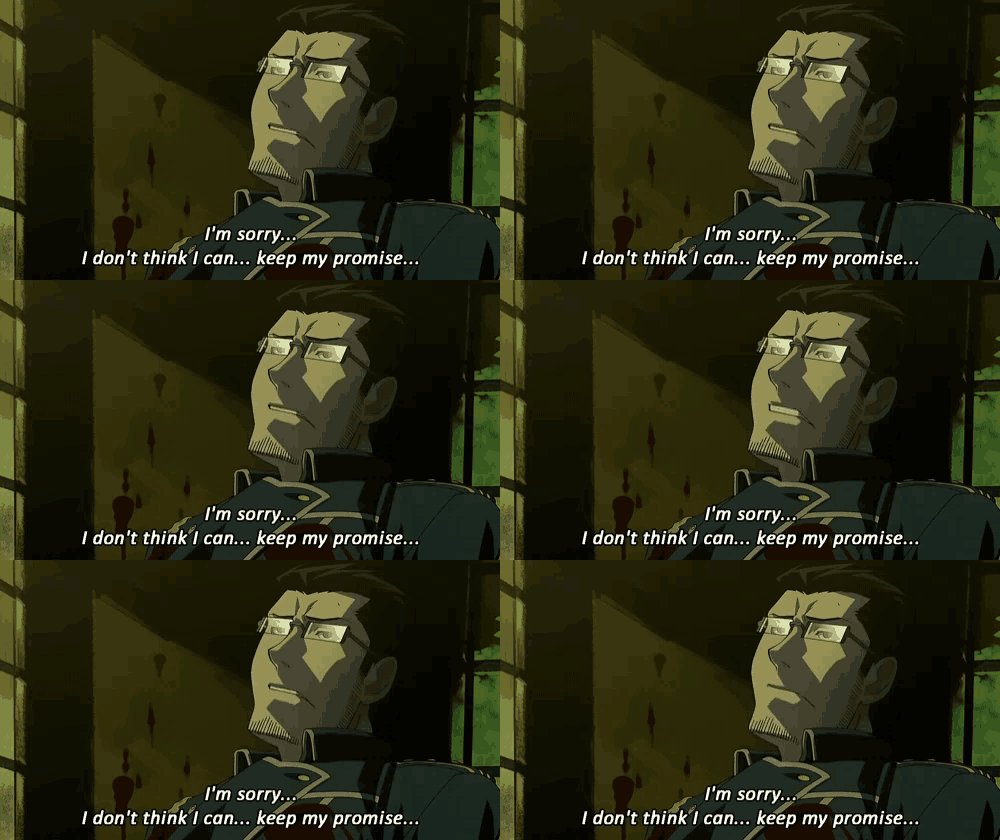
Roy Mustang, manliest of all men btw, is having the stomach rumblies that only homunculus hands can satisfy – and if you get that reference, congratulations, you’re old! And wouldn’t you know it, Envy just happens to be there, and just happens to be the homunculus who killed Maes Hughes. What can only be described as a cremation ensues. And it is satisfying.

9) Tokyo Ghoul: All this for one lousy date?

Our sweet boy 17 year old Ken Kaneki just cannot catch a break in the brutal and depressing anime that is Tokyo Ghoul. The series starts with him just discovering that he’s a ghoul after a freak accident leads to his blood becoming mixed with his date Rize. What follows is an absolute pile on from hungry ghouls and human ghoul hunters alike. Just when you think Kaneki’s suffering is over, he’s kidnapped and brutally tortured by Ghoul Jason (and these scenes actually made me feel ill). Much in the way that Ned Flanders had to endure the friendship of Homer Simpson, eventually, Kaneki snaps. Leaving the sweet innocence of his youth behind, he embraces the “kill or be killed” mantra, and goes fully feral on his torturer.

10) Blue Eye Samurai: don’t run afoul of Mizu

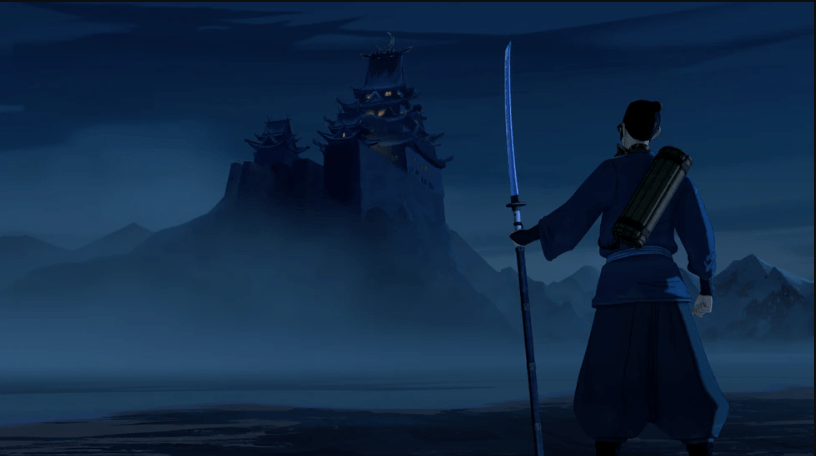
The entirety of Blue-eye samurai is a shout out to the great classic Ronin/samurai revenge movies – and I could have put them here just on the basis of them being the classics, but this is my list and I get to choose what’s on it. Anyway. Mizu, a blue-eyed, half-white orphaned woman, has literally cut her way through the toughest warriors Edo era Japan has to offer. And she’s about to get her revenge on 1 of the 4 men who might be her father: Irish born gun smuggler, Abijah Fowler. Fowler has a fearsome reputation himself, and hasn’t made it easy for her. Initially he stabs her, but like a true demon, she gets up, setting fire to the room. Fowler, for the first time, shows genuine fear as he turns to face her.

So what do you think makes a great revenge story? What’s your favourite revenge story of all time? Let me know!

Storytelling 101: What’s the deal with Chekov’s gun?

Who is Chekov, and why are we talking about guns?

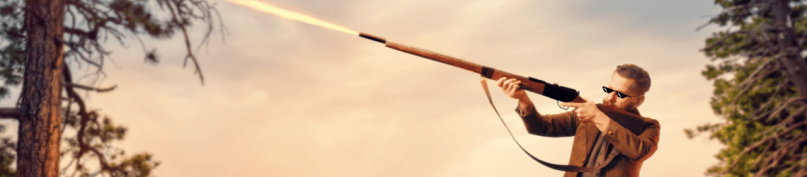
I’m paraphrasing here, but Russian playwright Anton Chekov once said, “If you have a gun on the wall in the first act, in the second or third, it must go off. Otherwise, don’t put it there”.

Go off, indeed, king.

There’s a number of dramatic principles and narrative techniques that we as writers can use to make our stories more engaging and dynamic. I don’t want to say ‘better’ because I’m not the authority on what counts as ‘better’. There’s writing out there on bestseller lists that I think is absolute tripe, and only popular because some menfolk can’t seem to get their acts together when it comes to satisfying their female partners (cough-fifty shades-cough). But who am I, a lowly modern day medieval peasant with only an A-level in English Language and Literature, to say what is good and what isn’t? I can only give my opinion and point you, dear reader, into a direction that I think might be helpful.

I plan to make this a series, exploring each of the ways writers can utilise tried and tested techniques to practice their craft, as I practice my own.

But really, I’m doing this for you. It’s all for you.

So what’s this about a gun?

Basically, Chekov’s gun refers to an item that appears in a story (usually in the first of a three-act structure) that becomes a significant part of the plot later on. For example, at the start of the story, the main character notices an unwashed knife left in the kitchen sink and makes a mental note to wash and put it away later. That knife becomes the weapon our main character plucks from the sink and uses to defend themselves against an intruder in the final act.

For most stories, there are rules that tend to apply if we want our story to be engaging to an audience. One of those rules is: if it’s not vital to the story, don’t include it. If it’s not enriching the world building, developing the characters, or serving plot, then there’s no point keeping it in. To paraphrase Chekov again, “if the gun’s not going to be fired, don’t have it in the story.”

You could argue that everything you’ve put in your story is vital to the plot and needs to stay. That’s your decision – writing is an artform, after all, and in the context of this rule: Chekov is a playwright. Can the rules of theatre translate into novel writing? (personally I think it can and often does quite well and vice versa – but this isn’t about me, it’s about you, the reader). Does a rule for one form of media count for another? How does one incorporate Chekov’s gun into other forms of writing?

Listen, I’m not the story police. I can’t tell you how to write. But: your audience may be expecting certain events to happen in a certain genre of story, and since you want to tell great stories, you might want to familiarise yourself with these events.

Let’s take a step back and think about our brains for a moment – don’t worry we’re not going too far into psychology territory, I promise. Our brains like the happy drugs. They’re filthy addicts, and they’ll do anything to get a hit of that sweet, sweet dopamine, endorphins, and all the other stuff that makes our meat suits want to live another day on this barren hellscape. And, one of the things that gives our brains the happy drug, is predictability.

It sounds counterintuitive – surely, we like things that are novel, new, and exciting? Well, yes, we do, but these can activate our stress response, and that’s how crossed wires can happen (and we end up loving rollercoasters or erotic asphyxiation). If you think about us as animals (well, duh), we get dopamine from stuff like chasing and catching prey (it’s why we like video games so much).

BUT!


Part of the enjoyment of that novelty is predicting the outcome and getting it right. If the rabbit weaves to the left, and you accurately predicted so and caught it, you’re going to feel pretty darn good. And you’ll receive further brain chemical rewards when your tribe gets to eat, and you’re commended for your hunting prowess. It’s the same for storytelling.

We love being able to predict what’s going to happen next. It’s why commercial pop music exists as a genre, and why Rogue One is the best Star Wars movie since the originals (fight me).


We like being able so sing along without fucking up the lyrics, or correctly guess who the killer is in the murder mystery. We typically enjoy being smug gits about stuff, and when we know how something ends, we can sit back and just enjoy the journey. By the way, its super cool to say “told you that would happen” every time you watch a film with someone. Your friends will definitely not want to throat punch you after the third or fourth time.

A way storytellers have incorporated this – whether originally on purpose or by happy subconscious accident – is through leaving breadcrumbs and clues for readers and viewers. Our brains can spot these clues and interpret them as we engage with the media. It makes the final outcome more subconsciously predictable, therefore less stressful for our brains. I hope that makes sense.


Now – if we watch something and it’s TOO obvious, we steer into boredom territory, because it’s no longer a challenge. It’s why TV shows for young kids are often seen as boring and predictable to adults (unless it’s Bluey. Bluey goes HARD).

On the other end of that spectrum, if we watch a movie and the killer turns out to be some complete rando who was onscreen, once, for two seconds at the beginning of the film and never appears again until they’re revealed, we’re going to be rightfully pissed. Every twist and turn in a story needs to be, in SOME way, predictable enough for it to be enjoyable without it being obvious or completely left field. It’s all about balance.

Remember kids: plot twists are only enjoyable if they make sense.

So, we’ve established that interesting, exciting (but subconsciously predictable) plots can make for engaging storytelling that gives us all the right brain chemicals.

This is why storytelling devices like Chekov’s Gun are effective. That knife in the kitchen sink that Stacy’s housemate forgot to put in the dishwasher in the first act suddenly becomes the one thing saving her from becoming plant feed when the villain shows up. It gives the audience a vital clue into the plot without spoiling it too much (if you do your job right) and then rewards them later in the story with a nice lil dopamine hit.


You’re welcome

There’s a variety of ways you can implement Chekov’s gun, depending on your genre. For romance, it could be an important love letter that is accidentally swept under a sofa and later revealed, confirming the writer’s true feelings in a pivotal scene. For Sci-fi, it could be a ray gun that’s actually just a cheap, novelty teleporter that becomes an important plot device when Lrrr, ruler of the planet Omicron Persei 8, is forced to shoot someone. The fun is in deciding which plot device you’re going to use and how well you’re going to hide it – just remember not to hide it too well.

Now, get back to writing.

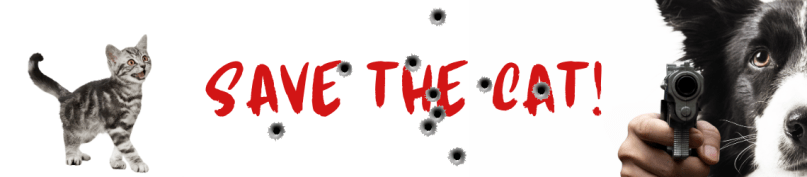
Save The Cat!

The literary device all the cool kids are talking about…

You know the scene, tale as old as time: There’s a cat in a tree, an old lady crying “Help!” and a heroic figure running to the rescue. Our hero climbs the tree (or flies up if he’s superman), plucks poor old puss from its branches, and returns the cat to its loving owner. Instantly, you think “wow, what a guy!”

What is ‘Save the cat’?

‘Save the cat’ is an old screenwriting device/technique, designed to quickly tell the audience who the hero of the story is. Its use has evolved over time, but its origins lie in early film and comic book media. For now let’s keep it simple: if you have a character on your hands that you want to be seen as heroic, have them rescue a cat (or puppy), or commit a small good deed that mildly inconveniences them. There’s many examples of this in film and comics (the example I’ve used here is Superman), and they all exist with one thing in mind: to get the audience to like the main character.

Why a cat?

Well. It’s something they don’t have to do. A hero could obviously commit a much greater, more dramatic act. Of course the hero has to save the world. They don’t have to rescue a cat from a tree. This small act of kindness shows the audience that the character is not just a hero, but a genuinely good person.

When I was studying literature at college, we didn’t look at many movies (the one we did study was American Psycho and to this day I’m not sure why), but I was aware of saving the cat as a trope. It was kind of a background knowledge, something you knew instinctively. How do we know who’s the hero? Well, they save the cat from a tree, of course. It’s what Superman did, and he’s the epitome of hero.

I’m going to quote a comment from the video I linked, because I think it perfectly encapsulates the idea of ‘save the cat’:

“A lot of people don’t really understand the saving the cat from the tree scene. It appears corny until you understand what the movie is trying to convey: Superman is virtually invincible. He could enslave humanity, he could kill anyone who doesn’t tow the line instantly, he could be King of the entire world, he could be psychopathic and do incredibly evil things and NOTHING could stop him… but he doesn’t. He’s got all those powers and he’s actually a really decent guy. He saves a little girl’s cat from a tree and is really kind to her and down-to-earth. It’s an important scene to establish his character.” – @Halfstar3

If you were to Google ‘save the cat’, you’ll find the term itself credited to Blake Snyder, American Screenwriter (known for blockbusters such as ‘Stop: or my mom will shoot!’ and ‘Blank Check’). In his book, Save the cat: The last book on screenwriting you’ll ever need, Snyder lays out the ‘winning formula’ for screenwriting (by the way, there’s 2 follow up books to this one, so is it really the last book on screenwriting I’ll ever need, eh, Blake?). The literal hero trope of saving the cat is much older than the 2005 book – not that I think Snyder has laid claim to the trope itself, more that he just coined the term as a storytelling device, thus giving it a tangible label. I’m not going to go into specifically the ‘save the cat’ beat sheet or structure here – there’s plenty of sources that outline it way better than I can.

Note: this isn’t entirely relevant, but I read in a blog post that Snyder’s framework is taken from the movie Aliens, which came out in 1986. Ripley sleeping in her pod as the camera pans down to the cat that she rescued is a great way to immediately convey her character, but I’m not sure why this is the example Snyder used (if he used it – I haven’t actually read the book and frankly, I don’t plan to, not for a blog post) when Superman did it in 1978, almost a decade earlier. (BTW I’m not ragging on the Alien franchise here, I am a HUGE Alien and Ripley fan so don’t come for me). I wonder if the Aliens version is an improved version of the iconic Superman deed.

Thing is, I think it doesn’t really matter all that much who used it first or coined the term first or where it came from unless you want to argue about it on the internet. What matters is understanding the point of it as a device (to convey the nature of the hero).

So how do I use it?

However you like! There’s a myriad of ways a writer can implement this for storytelling purposes, but for now I’m going to stick to 3 examples I think could work:

  1. Classic superhero
  2. Anti-hero or unlikely hero
  3. Reverse Uno (the ol’ switcheroo)

1) The Classic Superhero

Just like Superman, Spiderman, Ironman, Wonder woman, and all the other ‘mans, the superhero intro heavily features our main character saving someone or something. This is the classic of classic save the cat methods and it works for a reason. In film, there’s no quicker way to demonstrate the innate goodness of a character than by rescuing a small critter at the heros inconvenience. Superman is running late for a meeting as Clark Kent, but – oh no! The dearest, littlest old lady is crying for help! Her poor kitty is stuck in a tree and can’t get down. In an instant, Clark is transformed and soaring to the rescue. Just like that, we know he’s a true hero and a real nice fella.

2) The unlikely hero or ‘anti-hero’

They’re not a good guy, no. They’re in the middle of a bank heist, or they’re picking pockets, stealing bread or pulling pranks on wealthy businessmen. Maybe they work for the mob, or they’re a fantasy rogue, a questionable character, who, on the first glance, doesn’t appear to be heroic at all. They live for themselves, damn it, and unless you pay them you ain’t getting jack. Until… Right in the middle of their heist, they notice a car hurtling towards a puppy at a crossing. The driver? Unconscious. The puppy? Unaware of the oncoming danger until it’s too late. Our hero somersaults in at the last second, sweeping puppy up in an instant. In one fluid motion, they skid round, let go of the puppy, and sprint towards the now crashed car. There’s fluid leaking and smoke flowing out from beneath the bonnet… It’s gonna blow. The hero rips open the passenger door and drags out the injured driver, pulling him away from danger right before the car bursts into flame. A crowd gathers to celebrate the hero… but they are gone.

The audience now knows exactly what side our character is on, and it’s the side of good despite their misdemeanours. The audience can breathe a sigh of relief and trust that they are in safe storytelling hands.

3) Reverse Uno, bitch

Surprised? I knew you would be. Who could have known, that our sweet, kind hero of ages was actually the villain this whole time? Mwahahahaha!

This is a twist of ‘save the cat’ in that it lulls your audience into a false sense of security. We thought this character was heroic because they saved the puppy/kitten/child at the start of the story, but actually, it was all a farce, a cheap trick to get you to think they were a goody-two-shoes! Really, they sooner kick a cat than save it, and now they’re going to wreak havoc for our real hero/es.

These are just 3 ways a device like ‘save the cat’ could be used in storytelling – how you use it is completely up to you. That’s if you want to use it at all. There’s plenty of stories and plots that don’t require the main character to save anyone. For example, Lara Croft blasts her way through saving the world, wiping out several endangered species as she goes (technically that wolf attacked first, and really, when you think about it, it’s a kindness. They were all just existing there, trapped in an isolated temple, slowly breeding their way to genetic devastation). Anyway.

The beauty of ‘save the cat’ is that your main character could be introduced as not that likeable, but learn and grow into someone who can be heroic (for example, Megamind). Why not experiment with the idea? See if you can push what audiences interpret as heroic and turn it on its head? Make the cat rescue the hero. Make the old lady the villain – villains love cats! Make the hero a dog who saves the cat. Make the cat someone who doesn’t want to be saved (for example, the Incredibles when Mr incredible saves the suicidal man).

I could go on forever here. There’s loads you can do with this. Now go forth and write!

Non-writey ways to improve your writing

No, you don’t always have to ‘just write’.

It all sounds very preachy and privileged. Someone comes along with a bunch of advice that goes ‘instantly improve your writing!’ and I roll my eyes immediately. I’ll tell you now, there is no ‘one size fits all’ way to improve any craft, let alone a creative endeavour that’s so subjective and nebulous. What worked for me might be a nightmare scenario for someone else. That said, I think some of the things I’m about to list might come with a “well, duh!” reaction.

Let’s get into it, and if I miss anything, let me know in the comments. Also, ‘writey’ is definitely a word. If Shakespeare can make up words, so can I, damnit.

Expand your genre horizons

Sure, you love to read, and you read a lot of books. Most writers are also avid readers, that’s pretty much a given (even if many of us don’t get the time to read as much as we used to). That said, the quality and quantity of what you’re reading can vary greatly. If you want to write an epic fantasy, but all you read is steamy erotica, that’s not going to give you the right building blocks for the tropes and beats an audience would expect from fantasy. I know. I’m sorry.

progress begins outside of your comfort zone – and this one is a pretty hard pill to swallow, but I’ve said it before (and I’ll say it again): you need to the thing if you want to be the thing. You need to expand your horizons if you want to write more stuff. Want to write horror? You’re going to need to find out what makes good horror, and what better way than to read more horror?

It’s like learning the rules so you know which ones to break.

Watch more movies

Human beings simply love a good story. The media that humanity uses to tell stories has changed over the many centuries, but the essence of storytelling has remained the same. If you want to tell compelling stories that evoke emotion and bring people together, just like with reading, absorb more storytelling media. That includes movies. And, while movies are a very different media on the surface, there’s a lot we as writers can learn. A movie has far less time than a book to set a scene – but it also has immediate visual and sound advantage. A novelist has to create the images and sounds in the reader’s mind through words.

Next time you’re watching a movie, take note of the visual and sound storytelling that has been utilised. Pay attention to colour, background, images, music and clothing. How can you convey these in a book? Can you create a scene without visuals?

Socialise more

Human beings are a pack animal. A social species that experiences torment, illness, and even death, if we are separated from each other. We are tribal, and in numbers we achieve many great things. With that in mind: you cannot expect to be an exceptional writer in a vacuum. This sounds counter-intuitive, because it doesn’t fit the stereotypical image of the lone artist with the bottle of bourbon, typing away, lit cigarette bouncing on the corner of his mouth as he goes.

But that’s the thing. It’s not accurate, or healthy. If you want to learn how people behave, how people talk, how they act when they’re hurt, afraid, lonely, sad, happy, etc, you need to be around them. It’s essential for writing effective, realistic characters.

Study people going about with their day-to-day lives. Watch a couple on a date. Are they new, shy and awkward, afraid to say the wrong thing? Or, are they older, used to each other, familiar with each others habits? How do they talk? Is it short, sharp sentences pushed out through gritted teeth, or sing-song and sweet like a chirping bird?

Drink more water!

Well, duh. Drinking water is good for you, everyone knows that. It’s good for you, that’s true. However, staying hydrated is especially good for that grey matter inside your cranial cavity. Drinking plenty of water can help reduce your risk of stroke, migraines, tiredness, and a myriad of other things. If you want to improve your writing, make sure to drink your water!

While I’m at it, have a look at what you’re eating too. What we put into our bodies has a huge effect on what we can do and how we feel. Wherever possible, nourish your body. Get that brain food in yer.

Get outside

Get your butt outside and touch some grass – where possible. Some of us don’t have the luxury of countryside, and, for some of us, the outside is not a safe place. That said, for a significant number of us, there are outdoor spaces we can go. If you have a local woodland and are able, go for a walk in it. If you have a garden and the weather’s nice, go sit in it. Go enjoy the natural world. If we’re indoors for too long, without fresh air, we can get develop nasty things like respiratory illness. People who suffer with depression can experience an improvement in their condition with regular outdoor activities. Going outside certainly helps mine, so there might be something to it.

Basically, it’s not good for us to be sitting at a desk all day, every day. Go experience some of the beauty of the natural world. You might come back with some inspiration.

So that’s it – some non-writey ways to organically improve your writing. I hope you enjoyed this! Let me know what you think (even if it’s to tell me I’m talking nonsense). If you want to add ideas to the list, please do! Just head to the comments. Otherwise find me on Twitter and Tiktok (links in my contact page).

Also (shameless plug): you can find my debut novel EAT, available on ebook and paperback, right here.