What we can learn from Audra Winter

A cautionary tale to writers about getting lost in the sauce, girlbossing too close to the sun, and what really matters to your readers.

TLDR: it’s the writing.

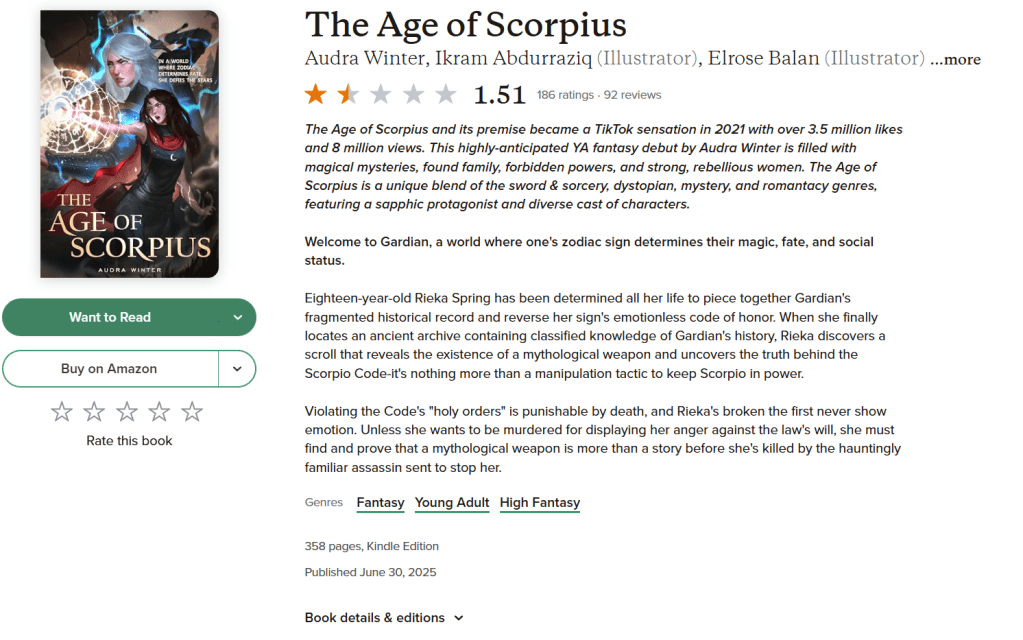
Earlier this year, new author Audra Winter made waves in the Booktok community with the release of her much anticipated debut YA novel, Age of Scorpius. But all that glitters is not gold, and the 22 year old author found herself facing backlash after the book reached readers’ hands, and reviews started coming in.

This is all everyone seems to be talking about right now – or maybe I just need to hard refresh my Tiktok and YouTube for you pages. Anyway. It’s all I’ve been seeing for the past month or so, and everyone seems to have thoughts about it. So I decided to add absolutely nothing of value to it by throwing my opinion in as well.
Let me be clear: I am not here to rag on this woman, nor accuse her of scamming, or call into question her past behaviours, or her neurodiversity. I am going to talk simply about the situation at hand, the cost of girlbossing too close to the sun, and why all the art in the world won’t compensate for poor writing. Also, this is all my opinion, this is all allegedly, please don’t sue me. Thank you.

Let’s dip our toes in then, shall we?

At first glance this idea looks pretty freaking amazing. Zodiac magic, a fantasy dystopian post-apocalyptic world? Beautiful artwork with a strong anti Ai stance? Lesbians???

Why, an idea this good could never fail!
Aw, fudge.

So, what happened?

So how does an idea this incredible, at a time when the market is primed and ready for it, miss the mark? (let me tell you: it’s the writing – there, now you don’t have to read the part where I ramble, unless you want to of course).

A very, very brief timeline from what I can piece together: In 2021, Audra was posting to Tiktok and introducing the world of Gardian (yes it’s spelled Gardian in the book, not guardian). This continued until around 2022, where things went quiet for a while after she signed with a literary agent and was preparing the book for sale to potential publishers. Audra re-emerged on Tiktok around 2024, re-introducing her book with a Kickstarter campaign.

Some time later Audra abandons the Kickstarter to focus on presales of the book via Tiktok shop, and it all takes off from there. Pre-orders flood in, and suddenly she’s sold around 6000 copies – unprecedented for an indie author. Audra flips the script here, pivoting from her previous pity marketing tactics to “I’m Audra Winter and overnight I became the owner of a 6 figure multimedia business”, with claims she has hired a team of 15 artists to further develop the world of Gardian, and that she had hired the editor of the Hunger Games to work on her book (allegedly, please don’t sue me).

People were very excited for this.
The problem

The book was not well received.

Reviews and reactions came flooding in, and soon the Goodreads page for The Age of Scorpius was swept up in a tide of 1 stars (as of checking yesterday, the rating is currently at 1.51). Readers began demanding refunds. Nightmare fuel for every author. I wouldn’t wish it on my worst enemy… Actually, I might. I’m a little petty. Is it petty to have a collage of 1 star reviews of your enemies books as your desktop wallpaper? You decide!
I had a look at the writing myself, and (in my opinion, don’t sue me), it does very much feel like it was written by a 12 year old (her age when she claims she started this world), and I can confirm that when I was 12 years old, I was writing fanfiction at a similar level to this. If you want to see it for yourself (the book, not my fanfiction), a sample can be found here.

Audra responds (with what I can only imagine is the royal ‘we’, because as the author, surely it’s only her that is responsible for the book, and not the artists or editors she hired), saying that the e-book version had missed a proofread and would be fixed. Fair enough.
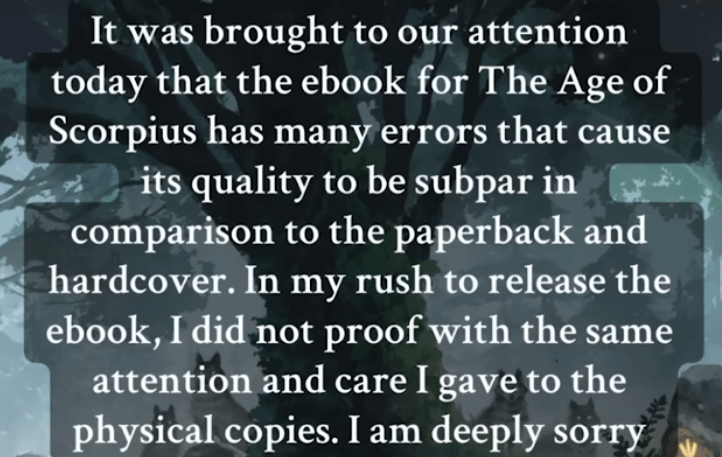
But, it doesn’t end there. There’s issues with the paperback too – grammatical flaws, confusing descriptions and a fair few plot holes. Audra steers the conversation away from quality issues to the impact on her mental health, and says she will be taking a break from social media. I’m not here to comment on this side of things, I want to stay with the writing – I’m adding this for context as to why people became so frustrated.

Now, forgive me here because the timeline gets a little skewed as I try to get my head around it all.

After all the feedback, critiques, and varying levels of criticism, Audra released videos saying that the book will be re-released with a new editor and new artwork from her team of 15+ artists. This has not been well received, with many stating that the artwork isn’t the problem, that it was never the artwork, and the writing needs to be significantly improved before anything else is even considered.

Throughout this, Audra does not seem to apologise or take criticism well, at times claiming that her main character is neurodivergent, therefore the prose and dialogue would be different to regular writing, or blaming the poor prose on previous editors (allegedly, don’t sue me). Many, including other neurodivergent writers, took this as a poor excuse for the subpar writing. People became increasingly frustrated with Audra’s responses, and criticisms quickly steered from the writing quality towards Audra’s character (which I am not here to dunk on. I don’t think anyone should be doing any dunking unless it’s biscuits in tea), and accused Audra of weaponizing her neurodiversity in the face of genuine critique.

Side note: I’m going on a slight tangent here, as a fellow autistic individual: It irks me whenever people accuse an autistic person of weaponizing their disability. It is a disability. Joely Black does a great job of breaking this aspect of the situation down, so here’s the link to her video.

Still, Audra does not help herself (in my opinion, please don’t sue), often appearing arrogant and self-assured. She’s made claims of having 10 years of experience in the publishing industry , writing 10 books (despite Age of Scorpius being her self-proclaimed debut novel), and of having her 10,000 hours of practice in the bag, making her a master in writing. By that logic, I should be the next Shakespeare. Trust, I’m not.
Unfortunately, just because you’ve been working on your world for 10 years, doesn’t mean you’ve been working in the publishing industry for 10 years (in my opinion, don’t sue me). The self published novel you put out at 14 doesn’t really count either (in my opinion, don’t sue me). I put out a comic series at age 14, and it was not good. No, I’m not going to be sharing it.
Audra also seems to struggle a little bit with truth telling (allegedly, don’t sue me). A bunch of people who are much better at researching than I, have found several inconsistencies with her story. One of these being why things ended with her agent. In one video, she tearfully claims to have been let go by the agent, in another she says she actually left them and decided to self publish (I’m not putting allegedly here, it’s in her own videos). And it doesn’t end there. This has caused people to question many things Audra has said, leading to accusations of her being a scammer (I personally don’t think she is, but who’s to say).

Get to the point!

Pride cometh before the fall.

Unfortunately for Audra, this is the internet. Much like elephants, the internet never forgets. And it never forgives. Jk, people do worse shit than this all the time and their careers remain completely unaffected. In two years, there’ll be another drama worse than this one, and Audra will be free.

What can we learn from this?

It’s all about the craft, maaan.

If Audra had been going to writing classes, seeking out workshops, practicing prose and fine-tuning her craft, then yes, the 10,000 hours in question would certainly help her on the way to becoming a master. BUT – with any craft, you never stop learning, and the second you declare yourself a master of something, someone is going to come along and humble you. A 12 year old is certainly not the master of much (not including Shaolin monk kids in this statement, because damn), and it doesn’t matter that she worked on her world for a decade if the world still doesn’t come across as well developed and well written.

Here’s what I, in my ‘unc’ status, advise to writers and soon-to-be authors who are worried about being in this situation: before you publish, git gud, scrub. It all comes back to: just write.

I mean it. Work on your craft. It’s not super fun or sexy, or gets you going viral on social media, it’s just good ol’ fashioned grinding (which actually can be quite fun if you’re into that sort of thing).

Anyone who’s played Hollow knight will know how important it is to git gud.
Screaming, crying, throwing up

If you truly want to be a writer, don’t get distracted by the shininess of being tiktok famous or being the next whatever – just write. Work on your craft. If you want to be tiktok famous, then by all means study the methods of Audra for self promotion. Go off, majesties.

All the other stuff aside, I do feel for Audra. She is obviously passionate about the world she’s created, and I think with some work and time, it could be something really cool. I can see why she had so many pre-orders. In a sense, she did everything right to promote Age of Scorpius. BUT – it just wasn’t ready, and the pride that inspired people to pre-order was the same pride that sent her flying too close to the sun. You can polish a turd all you want; no amount of pretty artwork, gilded pages, or girlbossing can compensate for immature writing. If anything, all the glamour set people’s expectations higher, which worsened everyone’s collective disappointment when reality hit.

I can’t even say this as a master, btw, because I am not a master at anything yet (unless its procrastination). I just have eyes and more than 1 functioning braincell.

Audra is living every one of our worst indie author nightmares. She’s at risk of becoming internet lore for all the wrong reasons, and we’ve all seen what that does to people. I genuinely hope it doesn’t happen to her. I know by writing about it, I’m contributing to the dialogue. Hopefully, it’s a contribution that doesn’t lead to negativity. This is a lesson for all of us about working on your craft and being willing to take criticism. By all means, share what you’re passionate about, share your joy of writing, share the joy of that world, but don’t lose yourself in the sauce, and don’t put the cart before the horse. Hey look, that rhymed. Maybe I am Shakespeare.

Sources

Image shows baby drooling at a burger, but the burger is a thesaurus in a bun

Opinion: Ima need you to stop eating thesauruses

One of the biggest mistakes new writers make, and how to avoid it.

I’m going to hold your hand when I say this (so you know I’m saying it with love) but STAAAHP eating thesauruses and puking them out onto paper. Stop it.


And before you get mad and start typing up those incredibly eloquent responses… calm down. This is to help you. And if you don’t want it, you don’t have to take it. We respect everyone’s boundaries here.

As a beta and arc reader I am sent books from authors wanting my opinion (some just want praise, but TOO BAD, I’m a prick), and over the last couple of years or so, I’m starting to see a pattern. Not a good one. With the recent rise and success of self-publishing (the success part mostly being uncle Jeff’s profit margins), anyone and their mums can write and publish a book with not too much effort (and with gen ai, you don’t even need to type. What a world we live in). This, in my opinion, is a good thing. Not the ai part. The freedom to self-publish part. Creativity should not be gate-kept, and I’ll stand by that statement, even if I also believe that some things should remain as inside thoughts or kept on AO3.


We don’t tell artists that they’re not artists just because their work isn’t in a physical gallery, so why do we keep shoving the mentality down everyone’s throats that you’re only an author if a traditional publishing house bought the rights to your book? Just look at furry smut artists. I know those guys are making bank. They’re still artists. Even if you don’t like it.

The downside, is that with the lowering of the gates comes a tide. Just as furry smut artists are still artists, any mediocre white dude who wants to jizz up a wall can call it art if he’s bold enough, and unfortunately I know a few circles who would eat that shit up. Not literally. Actually… Let’s not think about that.

Anyone can publish whatever they spew onto a page and call it a book. This is the cost of freedom, people. It’s a wild west out there. I’m not going discuss the quality of trad publishing taking a dive because yay capitalism, yay gen ai stealing our editing jobs, or say without a doubt that all self published books are terrible.

They’re not. Mine exists.

Let’s get back to the problem. Much like a weary teacher of gen alpha students, my advice to authors seems to be increasingly falling on deaf ears (if I don’t get messages hurling abuse at me). How dare I question their genius. They’ve done their ten thousand hours, damnit, so what do I know – I’m just a filthy, lowly reader. All that time I spent studying English Language & Literature at college means NOTHING.

The Problem

Short story for context: I recently received an arc of a book from an American writer who’d based their story in 20th century England. Admittedly I am a little more lenient with people who don’t live here, as they might have an idea of the UK that’s purely media informed, and therefore not accurate. It’s not actually Bridgerton over here, chaps. Even with that in mind, from the first page I was horrified. The main character spoke in such a strange, formal manner that I was immediately pulled out of the story. Side characters were also just as formal, using words that no one in their right mind would use unless they were giving an academic talk on the creation and development of the thesaurus.

“But I’m writing from another time!” – Sir, you are writing from the 90s.

We don’t talk like that. Nobody talks like that. We haven’t spoken like that since the Victorian era (arguably we didn’t speak like that in the Victorian era either), and unless your book is a historical drama akin to Jane Eyre, I do not want to see the Queen’s English appear on the page (Yes I know we have a King now, I don’t care).

You know why Colleen Hoover books sell so well? Because they use informal, every day language, and the masses relate to them. I’m not sure what that says about the masses, but there we go. And you know what? I enjoyed Verity, actually. There. I said it. I’m only using Hoover as a mainstream example here because A) her name is instantly recognisable and B) her writing style is very easy on the ol’ eyes. Of course, there are many authors who use poetic, achingly beautiful prose who are masters of their craft and bestselling authors. Brandon Sanderson is now a household name for fantasy writing, and I don’t have to pause every 30 minutes to look up a word that I’ve never seen before.

The point is that most of us plebs who read for entertainment don’t want to feel like we’re being beaten around the head by a thesaurus, and your job as a writer is to communicate clearly and effectively.

Anyway.

One of the biggest, hugest mistakes I see made by newer writers (I’ve also been guilty of it in my youth) is the use of overly formal language, with as many big words thrown in as humanly possible. Quite often it’s done to make the author appear more intelligent. I’m not sure where this behaviour stems from, perhaps from a fear of the writing coming across as YA (the horror), or maybe it’s to appease pseudo-intellectualist elitists who like to shit on any genre that isn’t the ‘modern classics’. Yes, yes, we’ve all read Animal Farm.

You don’t get brownie points for suffering, and you don’t get brownie points for weaponizing language. Not to sound like a very uncool school teacher, but it’s not big or clever. It just makes you look like this dude.


It’s like that one guy who works in a vinyl music shop, who hates anything popular regardless of whether or not it’s actually good. He’s the kind of guy who hates on K-pop Demon Hunters just because everyone else loves it. Or the “I’m not like other girls” girl who pretends to enjoy what she thinks is ‘high intellect hobbies’ for male validation because she has no sense of self, and would absolutely steal your man if she could. There is no greater anime villain. Besides Griffith, maybe.

So how do I avoid it?

Step 1: as with many things in life, the first step is to admit there’s a problem. Most newer writers who are very excited about their precious baby, do not want to hear bad things about it. Any form of criticism can feel like a personal attack, often because a certain amount of vulnerability comes with any creative output. I get it. I’m very sensitive about sharing my drawings, or my poetry in fear that someone will call it shit. But that’s the thing. I’m not trying to sell my poems or drawings to an audience. Those are mine. They are art, and can’t be judged unless I make them a product or offer them to the world.

Your novel that you want to sell to people, is a product. Like it or not. And you can absolutely say “well if they don’t like it they don’t have to buy it” and that’s fine… but you need to also be prepared emotionally when people don’t recognise you as the next Shakespeare and write reviews that reflect their customer experience.

Step 2: touch grass. I mean it. Go outside, sit in a park somewhere, or a bus, or a café, and just listen to people talking. Actually listen to how they talk. How people use slang depending where they are. How people out in the wild don’t adhere to hierarchy in the same way they would in a commercial or professional setting. How they talk to their children versus another adult. Does the server use a customer service voice then switch it up when talking to their co-worker? How do lovers talk to each other?

Most people have a limited vocabulary, especially in every day settings. I’m not going to say mastication when I mean eating. Think about how you talk to people on a daily basis. You need to converse. Or at least, consume enough examples of conversation to understand how it works. Most people can do this naturally (I say most – neurodivergent people may need to practice more than someone who is neurotypical).

Just as you wouldn’t want to be using gen Z slang in a historical drama (unless you’re deliberately subverting the genre, then by all means, go off, queen), you don’t want the Queen’s English featuring heavily in a modern, ordinary people setting.

While I’m at it – generations also speak differently and I see this happening with a lot of Gen X or Boomer writers who keep using their slang/speech for characters much younger than them. Heck, I even see it with Millennial writers.

Step 3: Really consider the type of media you are ingesting on a regular basis and understand the tropes/beats/prose that comes with it. If you want to write a gothic thriller, but you only read cosy romance, you’re going to have to consider what tropes are expected and acceptable in each genre, especially when it comes to prose. That’s not to say you can’t mix it up, but you have to understand the rules first in order to break them effectively.

What makes the Godfather so beloved? Why is Heat such a great freaking movie? Why is Bridesmaids so funny that one might pee a little every time they watch it? Why do we all love Chit??? Because of the way language is used to convey character and tone. If you want to write realistic, nuanced human beings who think and feel and get into hilarious shenanigans, you need it to reflect in the character’s voice and in the language you use.

A main character who speaks in nothing but riddles isn’t (typically) going to hook your readers.

Obviously I sent my feedback to the author and in the politest way I could suggested they consider a little more re-writing and editing before publishing, but I doubt they will. I always want to say to these authors to work on their craft first, then start looking at book publishing, but I can’t tell people how to live their lives. I can’t police someone’s creative journey (and rightfully so). I can only give my humble opinion on what I think is ‘good’ and even that’s going to look different to someone else. Who do I think I am, a literary agent???

Hopefully one day this author will naturally learn to move away from the stiff, overly formal writing that screams of a thesaurus being tortured for state secrets. Maybe one day I’ll stop being so judgy. One day.

TLDR: if you’re a new writer, try not to get bogged down in using big, fancy words and steer more towards natural dialogue. Study people in their natural settings and try using this as a reference for natural conversation and use of language. Consider what genres of media you consume and try to apply it to what you write.

What are your thoughts on this? Is it a worsening problem or am I just in a bubble? Am I the boomer in this situation, shaking my stick at the kids like an old man, accusing them of ruining writing with their tiktoks and their dark romance? Or is this just another rite of passage for new writers, that we all have to get through this phase before we learn better? Let me know!